
65% of Marketing Jobs Won’t Survive AI… But Here’s What Will
Mar 23, 2026
7 MINS
As AI compresses the need for execution, the marketers who survive won’t just be skilled—they’ll be visible, trusted, and impossible to ignore.
Marketing Isn’t Getting Replaced—It’s Getting Compressed
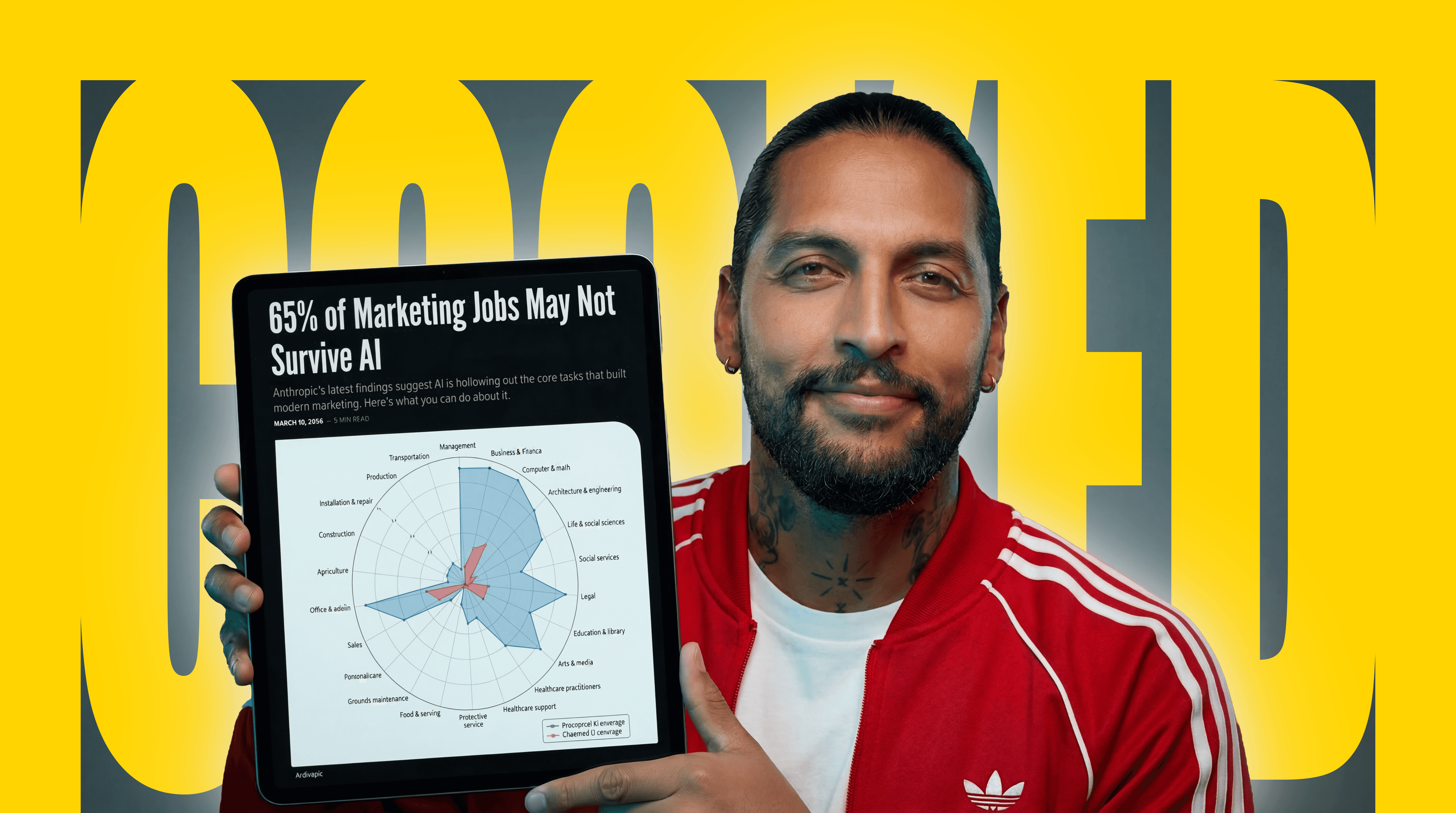
Let’s start with the stat that’s been circulating for a reason: up to 65% of marketing tasks could be automated by AI. This isn’t speculation pulled from thin air. It’s rooted in recent industry analysis, including insights cited in Adweek and supported by research from companies like Anthropic, who are actively building the very systems reshaping this work.
The important nuance here is that jobs don’t disappear overnight. What disappears is the need for as many people to do them. When strategy decks can be outlined in minutes and research can be synthesized instantly, the output doesn’t go away—the headcount does.
This isn’t a collapse. It’s a compression. And it’s already happening in real time.
The Real Problem: Marketing Was Always Built for This
According to research referenced a recent Adweek article, roles that are most exposed to AI tend to share a few traits: they are language-heavy, repeatable, and structured around patterns. Marketing checks every one of those boxes.
Anthropic’s own analysis of how AI systems are used in the workforce points to knowledge work, especially writing, analysis, and content production, as some of the most impacted categories. That puts a large portion of marketing directly in the line of fire.
This doesn’t mean creativity disappears. It means a lot of what we once labeled as “creative work” was actually structured execution. AI didn’t create that reality. It simply made it obvious which parts of the job were never as defensible as we thought.
Fewer Jobs, Higher Expectations, No Safety Net
We’re already seeing early signs of this shift reflected in hiring trends. The Adweek piece highlights a decline in marketing job postings, paired with an increase in expectations for those roles that do exist.
At the same time, broader studies from firms like McKinsey and Goldman Sachs have suggested that generative AI could impact hundreds of millions of jobs globally, with marketing, media, and administrative functions among the most exposed. These aren’t fringe opinions. They are macro-level signals.
The result is a tightening funnel. Fewer roles are available, but each role now demands more output, more speed, and more strategic thinking. The comfortable middle ground is disappearing, and the margin for being average is shrinking with it.
The New Divide: Interchangeable vs. Irreplaceable
What AI is really doing is drawing a hard line between two types of marketers.
On one side are those whose value is tied to execution. These are the roles centered around producing assets, writing copy, assembling decks, or analyzing data in predictable ways. According to the research, these tasks are among the most susceptible to automation because they follow patterns AI can learn quickly.
On the other side are those whose value comes from judgment. Taste, perspective, storytelling, and the ability to connect ideas in a way that resonates with real people are far harder to replicate. Even Anthropic’s findings suggest that AI is most effective when augmenting humans, not replacing those making high-level decisions.
The shift is no longer about how well you can execute. It’s about whether your thinking carries weight.
Why Personal Brand Is No Longer Optional
This is where the implications become personal.
If AI reduces the need for execution, then visibility becomes leverage. When companies are hiring fewer people, they are far less likely to take risks on unknown candidates. They hire people they already recognize, trust, or have seen demonstrate their thinking publicly.
A personal brand becomes the mechanism that builds that trust at scale. It shows how you think, not just what you produce. It creates familiarity before an interview ever happens and credibility before you need to prove it.
In a market shaped by AI, your work alone is no longer enough. People need to associate that work with you.
The Future Marketer Is the One People Recognize
The marketers who thrive in this environment will not necessarily be the most technically proficient. They will be the ones who consistently share ideas, document their thinking, and build a presence that compounds over time.
When execution becomes abundant, attention becomes scarce. The ability to capture and hold that attention is what separates those who remain relevant from those who quietly fade out of the market.
This is not about becoming an influencer. It’s about becoming identifiable. Known for a point of view, a way of thinking, or a specific domain of expertise.
The Bottom Line
The real question is no longer whether AI will take your job. It’s whether you’ve built enough signal that someone would come looking for you if it did.
The data points from Adweek, Anthropic, and broader economic research all point in the same direction. The work is changing, the roles are shrinking, and the expectations are rising.
In that environment, being good at your job is no longer a differentiator. Being known is.
Your personal brand is not a side project.
It is the layer that sits on top of everything else and determines whether you stay in the game.